2026 · open round · E · 15 points
A Typical Problem
Kyle Zhang & Nina Stadermann · writing systems · formal and computational
When you recognise an image as a snail, that quick judgment comes from a lot of behind-the-scenes processing: a rounded shell, two eyes poking out, an outstretched body. In machine learning these cues are called features — aspects of data that a system uses to decide on a label.
NACLOLabs wants an algorithm that takes an image and decides which of eight animals it is. The algorithm asks three questions as its features: is it underwater?, does it have legs?, and does it have a shell? It then looks up the row of the table matching those answers and produces the “output” column. If the answer to all three is no (written N), it says the image contains a snake. But NACLOLabs left some gaps in the table.
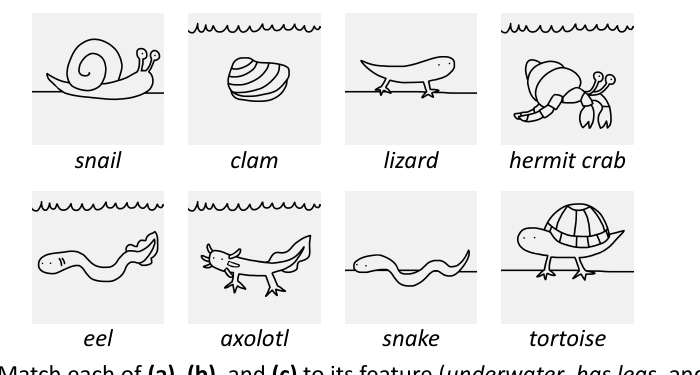
| (a) | (b) | (c) | Output |
|---|---|---|---|
| N | N | N | snake |
| N | N | Y | snail |
| N | Y | (1) | clam |
| N | (2) | (3) | eel |
| Y | (4) | (5) | lizard |
| Y | (6) | N | axolotl |
| Y | N | Y | tortoise |
| Y | Y | Y | hermit crab |
One way NACLOLabs can improve its algorithm is to use the same feature for several regions of an image, so that it outputs multiple values for each feature.
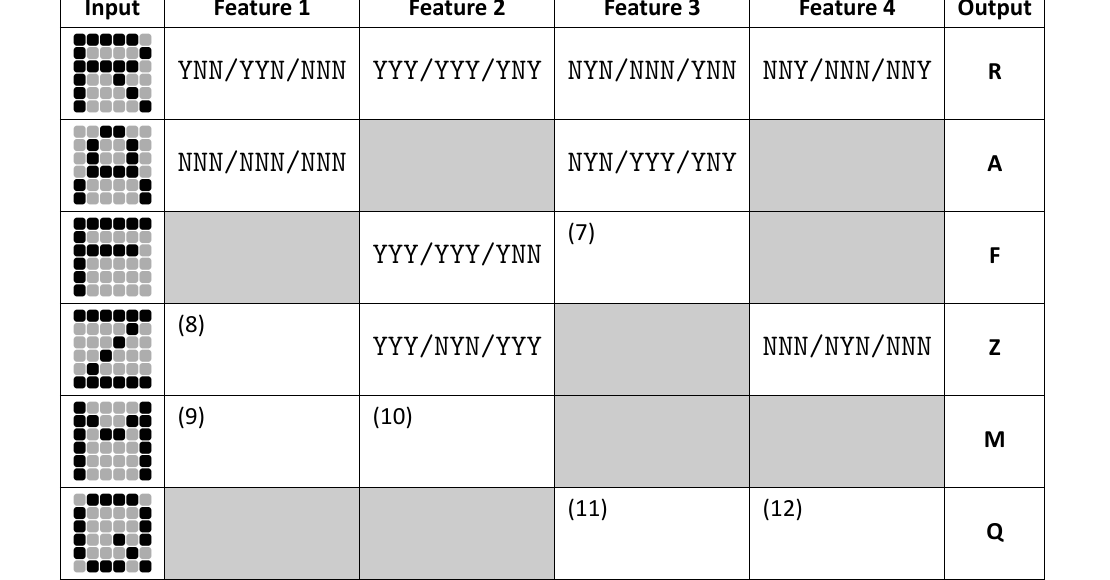
Optical character recognition works this way. NACLOLabs uses a basic font where every capital letter sits on a grid of thirty-six pixels. For each feature, the algorithm considers nine regions of this grid and outputs a sequence of yes and no answers.
Questions
0 of 19 correctMatch each of (a), (b) and (c) to its feature.
Fill in gaps (1)–(6) so that the algorithm works on all eight images.
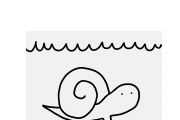
NACLOLabs runs the animal-labelling algorithm on an additional input and gets an unexpected result. Which animal does the algorithm output for the image shown?
Fill in gaps (7)–(12) in the feature table. You do not have to fill in the shaded cells.
The letter-labelling algorithm is run on two additional inputs, shown above, and gives unexpected results. Which letter does it output for each?
Sometimes the algorithm has two possible answers for a given input. Which two letters does it output for the input shown? Enter them in either order, separated by a space.
Explanation
Try the questions first. Use the Hint button next to any part if you need a nudge.
Reading the explanation is free. This problem is worth 15 points in the real exam.