2025 · open round · H · 15 points
There Is Another Hand
NACLO 2025 Problem Committee · number systems · historical and comparative · morphology · calendrical and counting
Most languages spoken in Europe today are Indo-European, brought to Europe by waves of migration 3000 to 8000 years ago. Before this, various other languages were spoken, such as the language of Minoan Crete, famous for its undeciphered writing system known as Linear A. Of these old European languages, only Basque survives, being spoken by around 800,000 people in northern Spain and southern France.
In the same way that French and Spanish descend from Latin, modern-day Basque descends from an older language called Proto-Basque. Although there are no speakers of Proto-Basque left, linguists can use historical methods to attempt to reconstruct what words in Proto-Basque may have looked like. For example, here is one proposal for the Proto-Basque numbers 1–9, given in a random order. Note that since these words are reconstructed, rather than known for certain, they are preceded by *.
| A. *bada-eri | B. *berr-eri-ahur | C. *atz-az-berr-eri |
| D. *be-oro-atz | E. *berr-eri | F. *atz-az-bada-eri-ahur-itzi |
| G. *atz-az-berr-eri-ahur-itzi | H. *atz-az-eri | I. *eri-ahur |
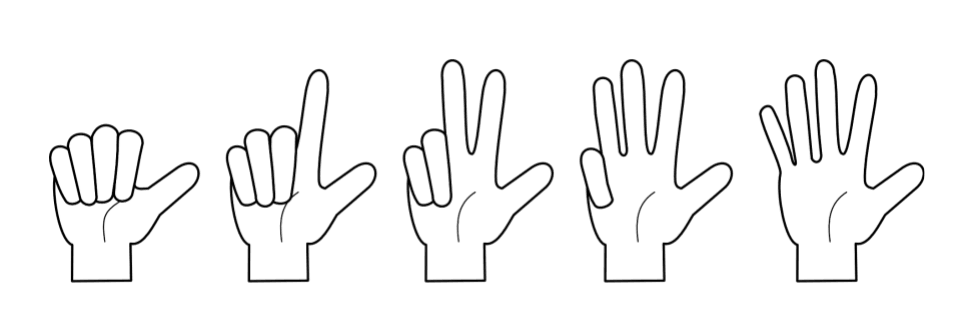
Each of the Proto-Basque numbers are made of smaller word-parts, with meanings related to counting on your hand. For example, *berr-eri literally means another finger.
Below are the word-parts of Proto-Basque numbers, with their English translations given in a random order. Note that the meanings of *be and *itzi are not relevant (linguists have other reasons to believe that they were present).
Proto-Basque word-parts:
- i. *ahur
- ii. *atz
- iii. *az
- iv. *bada
- v. *berr
- vi. *eri
- vii. *oro
English translations (random order):
- J. another
- K. finger
- L. hand
- M. (in) palm (of hand)
- N. there is
- O. with
- P. whole
Later in the problem you will also need the modern Basque numbers 5–10 in a northern dialect, given again in a random order:
| Q. zazpi | R. bortz | S. zortzi |
| T. bederatzi | U. hamar | V. sei |
Questions
0 of 22 correctDetermine the correct correspondences between the Proto-Basque words A to I and the numbers from 1 to 9.
Determine the correct correspondences between the Proto-Basque word-parts i. to vii. and their English translations J to P. Answer with the letter.
Determine which number from 5 to 10 each of the modern Basque numbers Q to V means. It may be helpful to know that the Basque z is very similar to s (although pronounced with the tongue touching the teeth), and that p and b are similar consonants.
Explanation
Try the questions first. Use the Hint button next to any part if you need a nudge.
Reading the explanation is free. This problem is worth 15 points in the real exam.