2024 · open round · A · 10 points
Holy Roman Shorthand
NACLO 2024 Problem Committee · writing systems · historical and comparative · transliteration
Before the printing press was invented, books had to be copied by hand. In Medieval Europe, most of this copying was done by monks. Poor lighting and other factors made this a difficult, often painful, task1 – so it’s no wonder that monks developed an extensive system of abbreviations to speed up their work!
For example, if a monk wanted to write the Latin words revertitur and illorum, they might have written:

Below are some examples of abbreviated Latin2 words you might find in a Medieval manuscript. Note that we’ve made some formatting changes when typing them up. Next to each one is the full (un-shortened) Latin word it corresponds to. In the right column, one possible English translation of the word is given. The English translations, and knowledge of Latin in general, aren’t necessary or helpful to solve this problem.
| Abbreviated Latin word | Latin word | English translation |
|---|---|---|
| reu9ti2 | revertitur | she returns |
| ꝑcul | procul | far |
| su9 | suus | its own |
| īp9p7uu | imperpetuum | not lasting |
| illoꝝ | illorum | of theirs |
| conversatio | conversation | |
| fortis | strong | |
| complexio | combination | |
| martis | of Mars | |
| caveret | he might fear | |
| introductum | introduced |
A1. Fill in the blanks (a) to (f) with the number (1–6) of the correct abbreviation from the list below:
1. fotis 2. ītoductū 3. 9u9sao 4. 9pxio 5. cau97 6. matis
A2. There can be many ways to abbreviate a Latin word. Below are 5 abbreviated words. 4 of them stand for the same Latin word. Write the letter of the one that does not match the others.
a. 9probatum b. cōprobatū c. compobatum d. 9probat9 e. 9probatū
In English, we sometimes use the symbol & as an abbreviation for and. This symbol originally comes from the Latin word et, meaning “and”. In some fonts, the way that this symbol is written makes it easier to see how it came from the letter e plus the letter t. Here is one example:
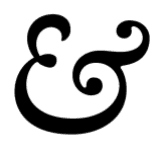
A3. Some monks used the symbol & in their writing in the same contexts where one of the symbols listed below might be used. Which one?
a. 7 b. 9 c. ī d. ō e. ū
A4. Give abbreviated forms for the Latin words in the table below, labeled (a) through (f). You should write your abbreviations using the numerical codes shown in the symbol bank, writing one number from 1 to 22 for each symbol. Notes:
- Some symbols appear multiple times in the symbol bank, always with the same number. You should use a given symbol no more times than it appears in the symbol bank. For example, there are four copies of n (number 9), so you should not use the number 9 more than four times in your answers.
- As A2 showed, there can be more than one way to abbreviate a Latin word. However, for this question (A4), there is only one correct abbreviation for each Latin word, because other ways of abbreviating would not satisfy the constraints imposed by the symbol bank.
- Some symbols will be left over in the symbol bank after you complete A4—see A5 for more details.
For example, if you thought the answer to (a) was d9, your answer would be 3 22, with 3 standing for d and 22 standing for 9.
| Latin word | English translation | |
|---|---|---|
| procatis | you (plural) ask | |
| notarum | of the known ones | |
| decernimus | we decide | |
| congnitio | knowledge [alternate form of cognitio] | |
| crux | cross | |
| petitur | it is sought for |
SYMBOL BANK (each symbol with its number and how many copies of it the bank contains):
| Number | Symbol | Copies in bank |
|---|---|---|
| 1 | a | 3 |
| 2 | c | 4 |
| 3 | d | 2 |
| 4 | e | 2 |
| 5 | g | 1 |
| 6 | i | 3 |
| 7 | ī | 1 |
| 8 | l | 1 |
| 9 | n | 4 |
| 10 | o | 1 |
| 11 | o (superscript o) | 1 |
| 12 | p | 1 |
| 13 | s | 1 |
| 14 | t | 2 |
| 15 | u (superscript u) | 1 |
| 16 | x | 1 |
| 17 | ꝑ (p with crossed descender) | 1 |
| 18 | ꝝ (crossed r-rotunda) | 1 |
| 19 | 2 (superscript 2) | 1 |
| 20 | 7 | 1 |
| 21 | 9 | 1 |
| 22 | 9 (superscript 9) | 2 |
A5. If you have completed A4 correctly, there should be six numbers left over in the symbol bank. The symbols corresponding to these numbers can be arranged into an English word that could be a good birthday gift for a Medieval monk. What is the English word?
- A quote from the 10th century about manuscript copying reads: “It dims your eyes, makes your back ache, and knits your chest and belly together. It is a terrible ordeal for the whole body.”
- Latin was the language of ancient Rome. In Medieval Europe, Latin continued to be used in many contexts, such as in religious and scholarly settings.
The rest of the questions are below, under Questions.
Questions
0 of 15 correctFour of the five abbreviated words stand for the same Latin word. Write the letter of the one that does not match the others.
a. 9probatum b. cōprobatū c. compobatum d. 9probat9 e. 9probatū
Some monks used the symbol & in their writing in the same contexts where one of these symbols might be used. Which one?
a. 7 b. 9 c. ī d. ō e. ū
Six numbers are left over in the symbol bank. The symbols for those numbers can be rearranged into an English word that would make a good birthday gift for a Medieval monk. What is the word?
Explanation
Try the questions first. Use the Hint button next to any part if you need a nudge.
Reading the explanation is free. This problem is worth 10 points in the real exam.